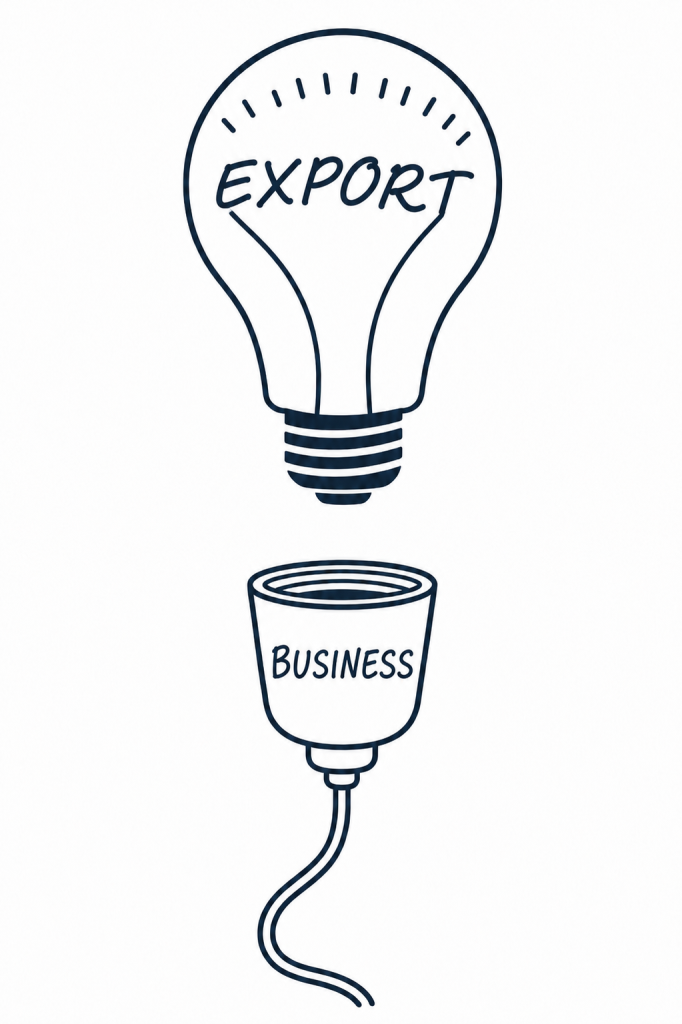
An export strategy can seem too long-term for a furniture manufacturer, especially when orders are needed today. Yet it is precisely the strategy that determines which market to target, which product to offer and which customer to pursue. In my experience, when furniture business owners are asked, “Why does your company need exports?”, nine out of ten initially give broad answers: to increase sales, utilise production capacity or earn more. But without a specific goal, day-to-day activities—building a website, running ads, attending trade fairs and looking for partners—can easily turn into chaotic motion that never leads to the desired result.
Once we ask the owner the right questions, the conversation becomes much more difficult:
Why do you need exports?
What exactly do you want them to deliver?
What should the company look like in three to five years?
What will change for the owner, the team and the business if the target sales volume is achieved?
In nine out of ten cases, furniture manufacturers cannot give themselves an honest and specific answer straight away. After several follow-up questions, a target usually begins to emerge: €1 million in annual export revenue, 50% of production capacity filled by export orders, five regular dealers or a presence in ten European countries.
But there is often no connection between that number and what the company is doing today.
The company wants to generate €1 million in export revenue within five years, but this month it has not allocated a budget for market research. It has not decided whom it will sell to. It has not adapted the product, prepared sales materials or made one person accountable for exports.
The ambition exists. The activity exists. What is missing between them is the strategy.
What Strategy Actually Means
Strategy is often confused with a plan, a budget, a task list or a large document presented to the team once a year.
But strategy is not a list of everything a company intends to do.
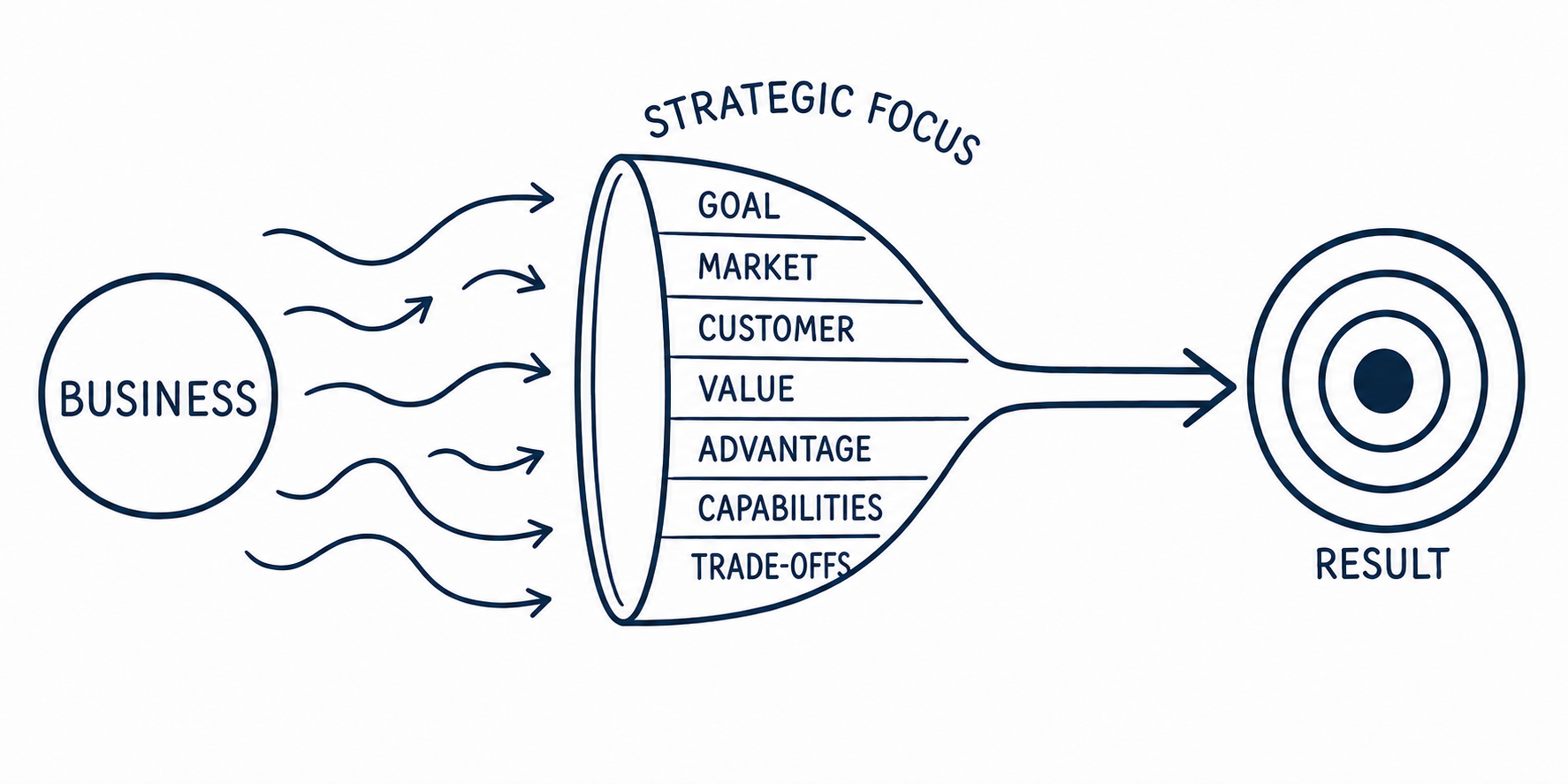
Strategy is a system of interconnected choices:
what goal we want to achieve;
which market we will operate in;
which customer we choose;
what value we offer that customer;
how we intend to outperform competitors;
which capabilities we need to build;
which opportunities we will consciously decline.
Professor and strategy expert Roger Martin explains the distinction in practical terms: planning concerns actions within a company’s control, while strategy is a coherent set of choices designed to position the company to win in a particular market. Opening a showroom, hiring an export manager or exhibiting at a trade fair is not a strategy. These are actions that may form part of a strategy—but only when it is clear why they are needed and whom they are intended to reach. This distinction is explored in the Harvard Business Review discussion, “The Difference Between a Plan and a Strategy”.
Strategy does not begin with a list of activities. It begins by defining where we want to go, whom we want to create value for and why that customer should choose us.
Strategy always involves choice. And choice means not only saying “yes” to something, but consciously saying “no” to certain markets, customers, products and activities.
If a factory simultaneously wants to sell furniture for homes, hotels, restaurants, offices and property developers in Germany, the United Kingdom, the United States and the Gulf states, this is not a broad strategy. More often, it is the absence of one.
Strategy is not a list of everything a company intends to do. It is a system of interconnected choices.
Strategy vs Tactics: What Is the Difference?
Strategy answers: Where are we going, for whom and how will we win?
Tactics answer: What exactly are we doing now to make that happen?
Strategy
Tactics
Focus on the contract furniture segment for small European hotel groups
Build a database of 100 hotel operators and purchasing managers
Enter the Dutch market through local dealers
Attend a relevant trade fair and hold 20 meetings
Compete through fast customisation of small batches rather than the lowest price
Prepare samples, a technical catalogue and a cost calculator
Reach €1 million in export revenue within three years
Appoint an export lead and set quarterly KPIs
Build a repeatable HoReCa sales channel
Launch LinkedIn outreach, an email campaign and cooperation with architects
None of these actions is inherently good or bad. Their value depends on whether they move the company towards its strategic goal.
Without a strategy, a factory can spend €30,000 on a trade fair, collect a hundred contacts and fail to convert any of them into sales. Not because the exhibition was poor, but because the company had not defined:
which buyer it was looking for;
which offer it would present;
which evidence would support its competitive advantage;
who would follow up with the contacts after the event, and how;
how much time and budget had been allocated for leads to move through the entire sales funnel.
Tactics without strategy create a great deal of movement. But movement does not necessarily mean progress towards the goal.
Do Companies with a Strategy Really Perform Better?
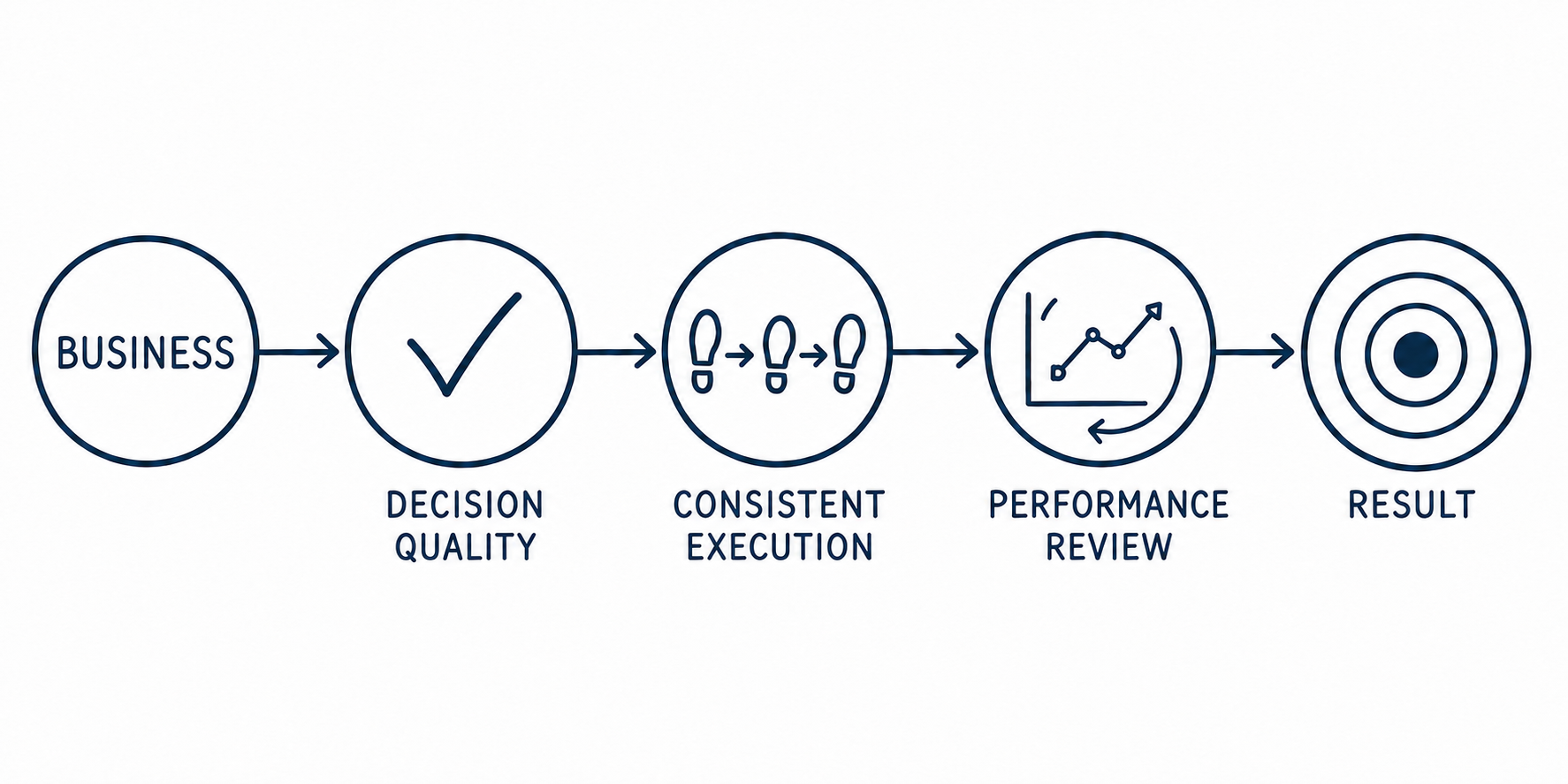
Research does not support a magical formula in which writing a strategy automatically produces profit. A formal document does not change a business on its own. What matters is the quality of the decisions, consistency of execution and regular review of results.
At the same time, academic evidence shows a consistent positive relationship between strategic planning and organisational performance.
A meta-analysis by Bert George and his co-authors examined 87 correlations drawn from 31 empirical studies. It found a positive, moderate and statistically significant effect of strategic planning on organisational performance. Importantly, the value did not come from merely producing a plan. It came from formal planning that included analysis, goal setting, stakeholder involvement and specific implementation actions. The study was published in Public Administration Review.
Another meta-analysis combined 29 samples covering 2,496 organisations. It also found a positive association between strategic planning and performance, although the strength of the relationship varied depending on the quality of the planning process. The paper appeared in the Journal of Management Studies.
A separate meta-analysis of formal strategic planning in small firms identified a positive and statistically significant relationship with financial performance. The effect was not dramatic in every individual case, but it remained consistent across the body of research. The study was published in Entrepreneurship Theory and Practice.
The findings of the McKinsey Global Institute and FCLT Global are also revealing. Between 2001 and 2014, companies with a long-term orientation achieved:
47% greater cumulative revenue growth;
36% greater earnings growth;
81% greater growth in economic profit than companies focused predominantly on short-term results.
These figures do not mean that any long-term plan guarantees growth. They do, however, show a fundamental difference between companies that make interconnected decisions with a future goal in mind and those that live only by the tasks of the current month.
Why a Business Without a Strategy Can Look Successful for Years
A furniture factory may operate for years without a clearly articulated strategy—especially if it has regular customers, access to inexpensive resources, a strong owner or stable demand.
The problem becomes visible when:
the domestic market contracts;
a major customer leaves;
production costs rise;
the company starts exporting;
the owner wants to step back from day-to-day operations;
random orders can no longer keep the factory’s capacity utilised;
competitors offer a similar product faster or at a lower price.
Without a strategy, decisions become reactive. An enquiry arrives from France, so the company calculates a quote for France. It is invited to a trade fair in Dubai, so it goes to Dubai. A competitor launches a new collection, so the company rushes to create one of its own.
Everyone is busy, but the company keeps setting off in a different direction.
The result is fragmented budgets, an overloaded team, an incoherent product range and no cumulative return from marketing and sales.
Where We Begin a Strategy Session
We do not begin by choosing a country. We do not begin with competitor analysis, advertising, exhibitions or a content plan.
We begin with one question:
What do you need all of this for?
Suppose the owner answers: “I want to export €1 million worth of furniture per year.”
That leads to further questions:
Why exactly €1 million?
Does this mean invoiced revenue or the value of signed contracts?
What share of the company’s total sales should it represent?
What margin should exports generate?
How many customers are needed to reach that result?
What should the average annual order value be?
How many orders can the factory actually produce?
What investment is required in the product, certification, marketing, the team and working capital?
Is the owner prepared to invest those resources before results become stable?
What will the company stop doing in order to focus on the chosen direction?
Only then does the number become a strategic goal.
For example, if a factory aims to generate €1.2 million in annual export revenue within three years, and the average customer contract is worth €100,000 per year, it will need approximately 12 active customers.
If one in every ten qualified sales conversations converts into a contract, acquiring 12 customers will require about 120 substantive negotiations. And generating those negotiations will require a much larger number of initial contacts.
The goal now begins to influence today’s decisions:
how many potential buyers must be identified this quarter;
how many meetings the export manager should hold;
which samples and materials are needed for sales;
what budget should be allocated;
when the first pilot contract should be secured;
which indicators should be reviewed every month.
This is how a company connects the result it wants in three to five years with the work that must be done today—and every day.
Why a Furniture Manufacturer Needs an Export Strategy
An export strategy is not intended to predict the future down to the last order. That is impossible.
It is needed to:
Focus Resources
A company cannot work equally well across every country, segment and sales channel.
Choose the Right Customer
A dealer, hotel operator, property developer, architect, furniture brand and end consumer all use different purchasing criteria.
Adapt the Product
Dimensions, materials, construction, packaging, certification and documentation must suit the specific market and channel.
Calculate the Economics of Market Entry
Export development requires investment long before it becomes a stable source of revenue.
Align the Team
Production, marketing, sales, product engineering and finance must work towards the same goal.
Distinguish an Opportunity from a Distraction
Not every enquiry and not every trade fair deserves the company’s resources.
Measure Progress
Once the goal is defined, it can be translated into annual, quarterly and monthly indicators.
Strategy does not eliminate change. On the contrary, it helps the company assess new circumstances more quickly: has the route to the goal changed, or is the business simply being distracted by yet another opportunity?
Strategy Is Not a Five-Year Document
In the context of war, unstable logistics, labour shortages and fluctuating demand, a Ukrainian business may reasonably ask: “What strategy can we have if we do not know what will happen in six months?”
But uncertainty does not reduce the need for strategy. It makes strategy even more important.
The strategic horizon may be three to five years. At the same time, the tactical plan should be reviewed quarterly and the key indicators monthly. The first target country may change, as may the sales channel or sequence of investments. Yet the owner must still understand what kind of company they are building and which criteria will guide its decisions.
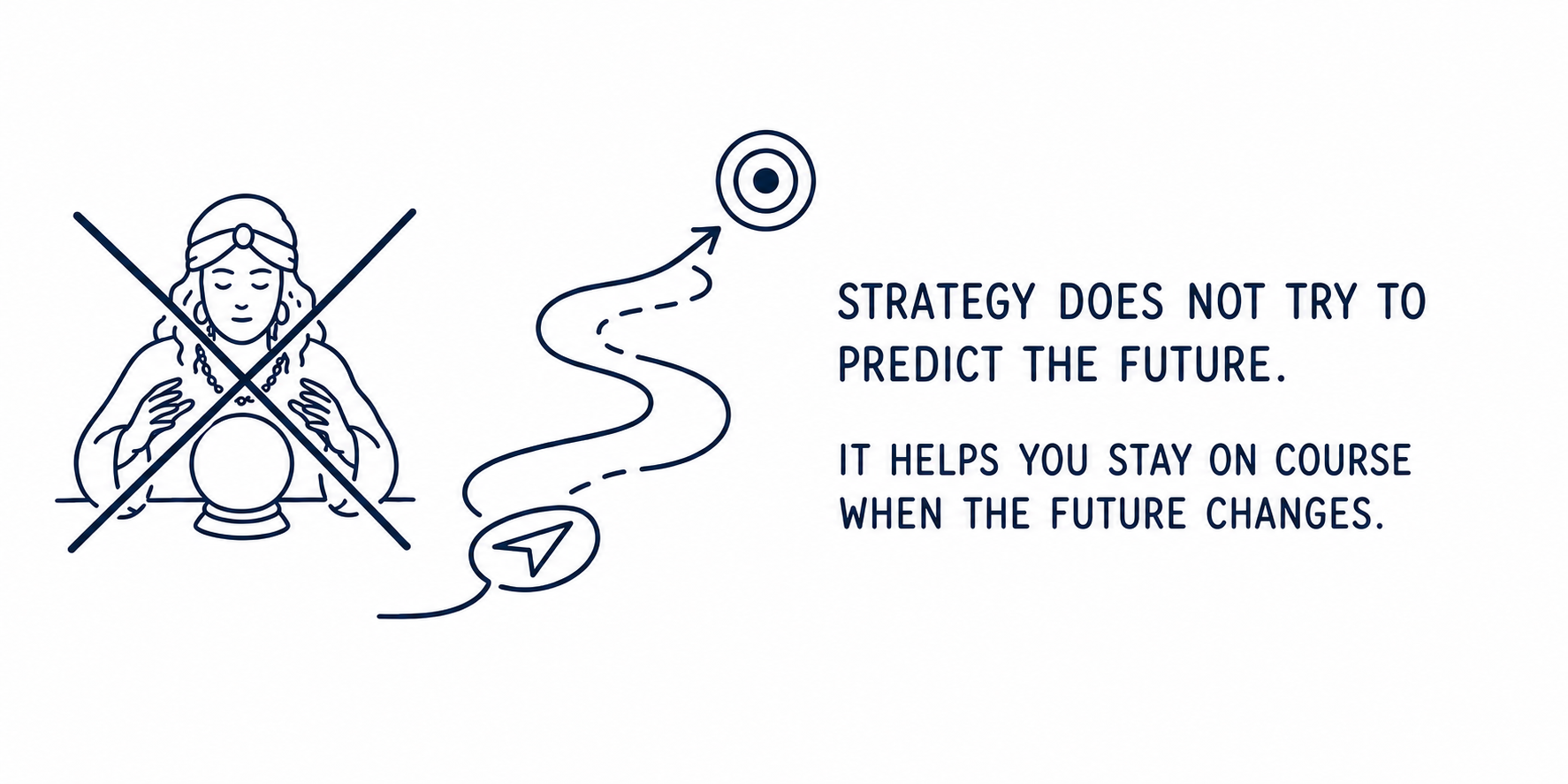
Strategy is not an attempt to predict the future. It is a way to avoid losing direction when the future changes.
Start with One Question
Before planning a new website, exhibiting at an international trade fair, hiring an export manager or launching an advertising campaign, ask yourself:
What exactly should change in our business over the next three to five years as a result of exporting?
Avoid answers such as “become well known in Europe” or “win more orders.” Define the result in numbers:
target revenue;
export share of total sales;
target margin;
number of regular customers;
priority markets;
customer segment;
product offer;
the owner’s future role in the business.
Then ask a second question:
What must we start doing this month to make that result possible?
If there is no clear connection between the two answers, the company does not need another list of marketing activities. It needs a strategy.
Oakhunt helps furniture manufacturers assess their export potential, select priority markets and customer segments, build a financial model and turn a long-term goal into a practical action plan.
If you are considering exports – or are already investing in them without seeing consistent results—let us begin with the essential question: why does your company need exports, and what exactly should they deliver for the business?


No responses yet