

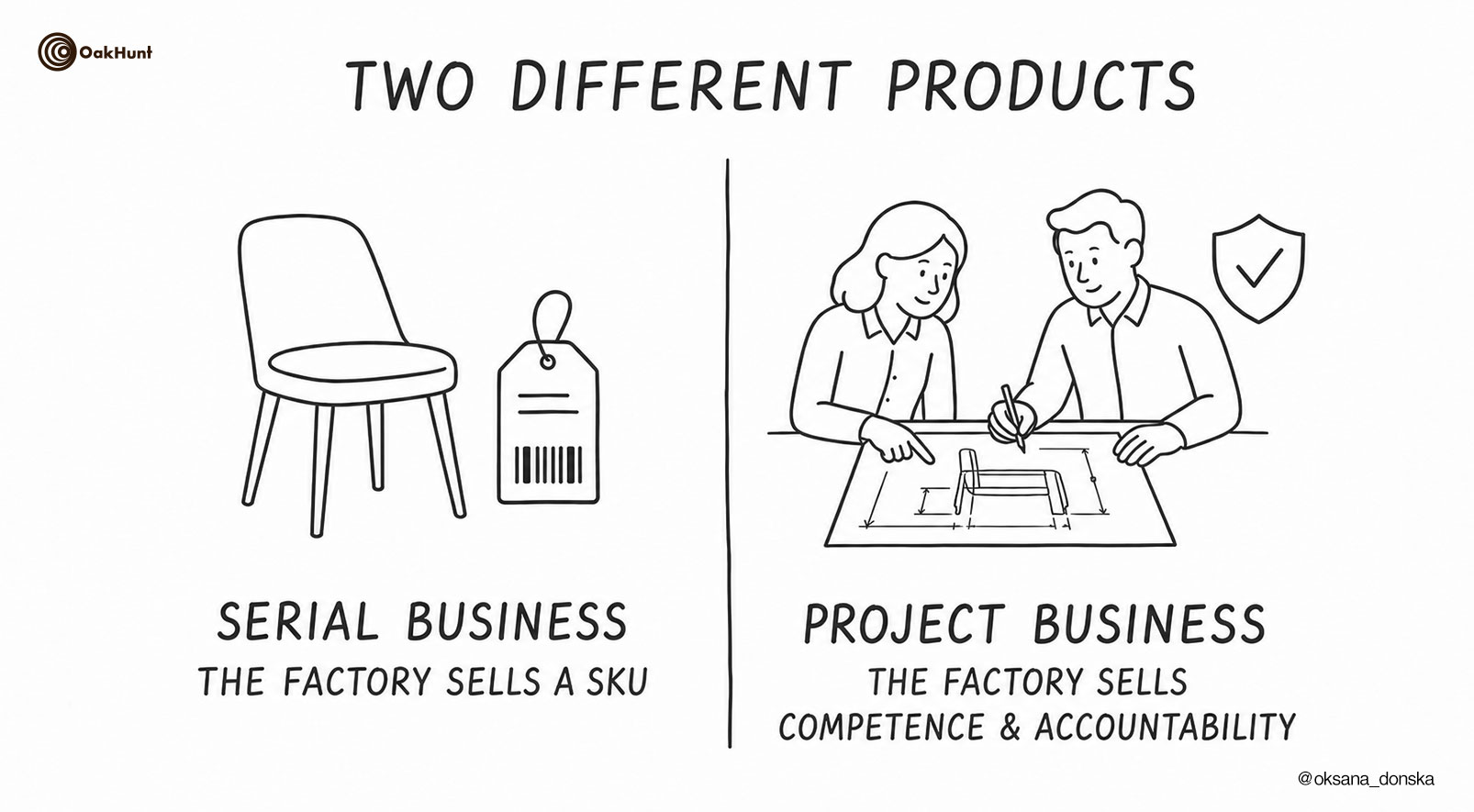
When entering international markets, furniture manufacturers often begin by choosing a country: Germany, the United Kingdom, the Netherlands, the United States, or the Middle East. But before analysing any market, they need to answer a more fundamental question:
What exactly will the company export: a serial product or its ability to deliver bespoke furniture projects?
This is not simply a choice between identical and individually designed furniture. These are two business models with different economics, sales channels, marketing requirements, team structures, and scaling potential.
A serial manufacturer invests in a collection, a brand, and distribution. A project-based manufacturer invests in trust, expertise, individual quotations, and a partner network. Both paths can be profitable. But trying to promote them in the same way almost always wastes time and marketing budget.
Export does not begin with finding a buyer. It begins with defining the product that a company can consistently sell, manufacture, and deliver abroad.
Serial Furniture: Invest First, Scale Later
The serial model means that a manufacturer offers pre-developed products with defined dimensions, materials, colours, construction, and pricing.
Customers may choose an upholstery colour, finish, table size, or sofa configuration, but they do not change the product’s underlying construction logic.
This model includes:
- tables, chairs, and cabinet furniture for the home;
- children’s furniture;
- bedroom and living-room collections;
- outdoor furniture;
- serial furniture for restaurants, hotels, and offices;
- modular sofas;
- storage systems with a limited range of configurations.
The main advantage of a serial product is the ability to repeat a sale without repeating the development process. One well-designed chair, table, or chest of drawers can be sold tens of thousands of times in different countries.
However, this scalability requires upfront investment. Before achieving stable sales, a manufacturer must finance design, engineering documentation, prototypes, testing, photography, catalogues, material samples, packaging, and promotion.
How Serial Furniture Enters Export Markets
The principal sales channels include the following.
Importers and distributors
They purchase furniture and handle local sales, sometimes also providing warehousing, service, and dealer support.
Furniture retailers and multi-brand showrooms
The brand needs samples, a clear price list, reliable lead times, and sufficient margins for the seller.
Designers and architects
This channel is particularly important in the mid-market, upper-mid-market, and premium segments. Professionals need 3D models, technical specifications, material catalogues, and trade terms.
The contract furniture market
Restaurants, hotels, offices, student accommodation, and other commercial projects can generate significant volumes, but they require testing, certification, and predictable production.
Direct e-commerce
This works best for furniture that can be easily configured, purchased, and delivered without lengthy consultations.
Marketplaces
They can help test demand, but they often intensify price competition and weaken control over brand positioning.
International furniture trade fairs
For a serial brand, an exhibition stand effectively becomes a temporary showroom. Buyers evaluate not only the product but also the coherence of the collection, the team’s readiness, and its sales potential.
This is why selling serial furniture abroad solely through cold outreach is difficult. Seeing one attractive product is not enough for a potential partner. They need to understand whether they can build their own sales around it.
Custom-Made Furniture: Selling the Ability to Deliver a Project
In the project-based model, the final product emerges only after an enquiry has been received. It may include:
- built-in furniture;
- kitchens and walk-in wardrobes;
- furniture packages for hotels and restaurants;
- retail fixtures;
- office furniture;
- custom pieces for private interiors;
- fit-outs for apartments, yachts, or premium real estate.
There is no need to develop a complete serial collection at the outset. However, the manufacturer must demonstrate its technologies, materials, the complexity of completed work, and its ability to manage a project.
The buyer evaluates:
- how accurately the company reads drawings;
- whether it can engineer a viable solution;
- how quickly it prepares a quotation;
- whether it works with materials and hardware recognised in the target market;
- how it controls quality;
- who carries out site measurements and installation;
- how the manufacturer responds to changes and claims;
- whether it can meet the deadlines of a construction project.
In the serial business, a factory sells a SKU. In the project business, it sells competence and accountability.
How to Promote Custom-Made Furniture Abroad
Personal selling and partnerships are much more important for this model:
- direct contact with architecture and interior design studios;
- partnerships with local general contractors;
- cooperation with fit-out companies;
- work with developers and hotel operators;
- participation in tenders;
- referrals from previous clients;
- a local sales representative;
- a partner for site measurement, installation, and after-sales service;
- LinkedIn outreach aimed at specific decision-makers;
- professional real estate, HoReCa, retail, and contract trade fairs.
The website of a project-based manufacturer should also differ from that of a serial brand. Instead of dozens of product pages, it should prioritise case studies showing the brief, scope, materials, complexity, timeline, and result.
Serial Production, Customisation, and True Bespoke Are Not the Same
Between standard serial production and fully bespoke manufacturing lies a hybrid model: serial furniture adapted to a specific commercial space.
The manufacturer has a catalogue of existing models with proven construction, established production processes, and predictable costs. At the same time, a designer, architect, or venue owner can adapt the product to a project by choosing the fabric, colour, and finish, adjusting dimensions, or ordering the required quantity.
One Ukrainian example is KITASS, a company specialising in HoReCa furniture. Its catalogue contains dozens of models of chairs, bar stools, armchairs, sofas, tables, and pouffes. For specific restaurants, cafés, hotels, and public spaces, serial models can be adapted through finishes, fabrics, and dimensions.
This system reduces costs compared with developing every item from scratch. The client receives furniture aligned with the interior concept, while the manufacturer retains the advantages of a repeatable product: proven construction, established production technology, and the ability to manufacture in series.
The KITASS portfolio features completed projects for restaurants, cafés, beach clubs, coworking spaces, developments, and other commercial interiors. The company also states that it works with designers, architects, project organisations, and dealers, and exports furniture internationally.
For Ukrainian manufacturers, this is one of the most realistic routes into the contract furniture market:
- create a catalogue of core models;
- offer a defined selection of fabrics, colours, and finishes;
- establish acceptable limits for dimensional changes;
- prepare technical files for designers;
- show completed projects, not only individual products;
- quote standard and modified orders separately.
This is no longer the traditional sale of an identical serial product, but neither is it fully bespoke manufacturing. In effect, the company sells a ready-made product platform that can be adapted to the requirements of a particular HoReCa project.
Which Price Segment Suits Each Model?
| Price segment | Serial furniture | Custom-made furniture |
| Economy | High volumes, minimal options, and strict cost control | Rarely viable because manual work and communication represent too large a share of the price |
| Mid-market | The most competitive segment; requires strong design, pricing, a stock programme, or fast production | Viable for kitchens, wardrobes, and standardised solutions with selectable dimensions |
| Upper-mid-market | A strong segment for design brands, contract furniture, and D2C sales | Works well with architects, private interiors, restaurants, and smaller hotels |
| Premium | Requires a distinctive identity, original design, quality materials, showrooms, and international promotion | A strong fit: clients pay for craftsmanship, service, and execution complexity |
| Luxury | Limited editions, renowned designers, collectible value, and a global showroom network | Unique private commissions, yachts, residences, exclusive materials, and personal project management |
Serial production has an obvious advantage in the lower price segment. Individual design, approvals, and installation cost too much relative to the furniture’s final price.
In the premium and luxury segments, both models can coexist. A serial brand sells recognisable design, while a bespoke manufacturer sells uniqueness and personal attention.
Global Examples: Similar Segments, Different Models
Sandalyeci and Billiani: Two Ways to Sell Chairs to the HoReCa Market
Turkish brand Sandalyeci and Italian brand Billiani operate in a similar segment: both manufacture serial chairs and other furniture for restaurants, hotels, and public spaces. Their marketing models, however, are different.
| What we compare | Sandalyeci | Billiani |
| Core offer | A broad catalogue of models that can be adapted to a specific venue | Designer-led serial collections with a strong and consistent identity |
| Main marketing focus | The completed project and the manufacturer’s capabilities | The product, collection, and its designer |
| What the portfolio shows | Project scale, supply complexity, materials, and customisation | How a specific model is integrated into interiors in different countries |
| Main sales channels | Direct project sales, architects, specifiers, and international showrooms | Dealers, distributors, architects, and contract partners |
| What the client buys | A proven model that can be adapted to the project | A recognisable Italian design product |
| How the business scales | Through new projects, showrooms, and manufacturing flexibility | Through international dealer distribution of repeatable collections |
Sandalyeci’s case studies show the client’s brief, the furniture supplied, modifications to fabrics, finishes or dimensions, quantities, and the completed interior. This type of portfolio sells the factory’s ability to deliver a comprehensive HoReCa order.
Billiani focuses on the model name, its designer, the design concept, and the product’s use within an interior. The completed project reinforces the value of a specific serial chair rather than demonstrating how extensively it can be modified.
Through its portfolio, Sandalyeci sells the manufacturer’s capabilities. Billiani sells the value and recognisability of a serial product.
This comparison shows that even within one product category, the portfolio, content, and sales channels must reflect what the factory actually offers: an adaptable solution for a project or a finished designer product.
Valcucine and Lanserring: A Product System versus a Bespoke Process
The difference between premium serial kitchens and bespoke kitchens is not that one is customised while the other is not. At this level, almost every kitchen is planned for a particular space and client. The real distinction is the starting point of the project.
Valcucine builds its offer around developed kitchen systems and recognisable collections. Dealers use these systems to create an individual composition, selecting modules, materials, finishes, and technological features for a particular interior. The resulting kitchen may be unique, but it remains based on an established product and engineering platform.
Lanserring places the bespoke process at the centre of its offer. The company can begin with the client’s lifestyle, an architect’s drawings, or an initial design concept and then develop the cabinetry, proportions, materials, and details specifically for that project. Its service extends from the first sketch to production and installation.
| What we compare | Valcucine | Lanserring |
| Starting point | An established kitchen system | The space, brief, and client’s vision |
| What is already developed | Structures, modules, mechanisms, and collections | The working method and manufacturing competence |
| Customisation | System configuration, materials, colours, and selected special elements | Construction, dimensions, details, and materials can be developed for the project |
| Principal asset | Brand, design, and engineering platform | Team, craftsmanship, design, and project management |
| Sales model | Primarily through showrooms and international partners | Direct cooperation with clients, architects, and interior designers |
| Scaling model | Repeating a proven system in different configurations | Increasing the capacity of the design, production, and project teams |
A premium kitchen system adapts an existing product platform to the space. A true bespoke manufacturer develops the product from the space and the client’s brief.
Both models require design, planning, and installation expertise. However, they scale differently. Valcucine can reproduce its engineering knowledge through collections, modular systems, and an international dealer network. Lanserring scales through the competence and capacity of its designers, craftspeople, and project managers.
How Much Does It Cost to Develop a Furniture Collection?
There is no universal figure. The budget depends on the number of pieces, construction complexity, materials, number of prototypes, and the share of work completed in-house.
For a collection of 12–17 pieces, an indicative budget may look like this:
| Stage | Indicative budget |
| Market research, positioning, and concept development | €3,000–10,000 |
| Designer or design-team fees | €8,000–30,000 |
| Engineering and production preparation | €8,000–25,000 |
| Prototype production and refinement | €15,000–50,000 |
| Testing and certification | €3,000–15,000 |
| Packaging and logistics testing | €2,000–8,000 |
| Naming, brand identity, and catalogue design | €4,000–15,000 |
| Photography, video, 3D visualisations, and website | €8,000–30,000 |
| Material samples and an initial sales kit | €3,000–10,000 |
Overall estimate: €54,000–193,000, excluding the first production batch, an international trade fair, and an advertising campaign.
For a Ukrainian factory with in-house designers, engineers, a prototyping workshop, and a content team, direct external expenditure may be lower—approximately €30,000–80,000.
This does not mean the development truly costs less. Part of the budget is simply hidden in team salaries, materials, machine time, and the reworking of unsuccessful prototypes.
The cost of developing an upholstered furniture collection is generally higher because of seating ergonomics, frames, fillings, fabrics, testing, and the need to produce several full-scale prototypes.
If the goal is not only to create the products but also to launch them properly in the European market, the budget should additionally cover:
- €15,000–50,000 for participation in an international trade fair;
- production of exhibition samples;
- transport and stand installation;
- samples for dealers;
- an export manager;
- local representation;
- a marketing campaign lasting at least 6–12 months.
A beautiful collection without a sales budget risks remaining an expensive set of prototypes.
Is It Cheaper to Enter Export Markets with Custom-Made Furniture?
Initially, yes. A project-based manufacturer does not necessarily need to invest in 15 prototypes, an extensive photoshoot, and warehouse stock.
The following may be enough to get started:
- 5–10 well-documented completed projects;
- an English-language presentation;
- a website with case studies;
- a clear description of production capabilities;
- material samples;
- a transparent project-quotation process;
- an English-speaking manager;
- a database of prospective architects, contractors, and developers.
However, every new project requires a significant amount of unpaid work before a contract is signed: analysing drawings, selecting materials, developing construction solutions, preparing estimates, and negotiating.
Project-based export therefore has a lower entry threshold but is harder to scale. The number of simultaneous orders is limited not only by production capacity but also by the capacity of the project team.
What Should a Ukrainian Furniture Manufacturer Choose?
The serial model is suitable if the company:
- can invest before generating its first sales;
- has stable serial-production capabilities;
- can maintain consistent quality;
- can provide sufficient dealer margins;
- is prepared to develop its collection regularly;
- has the resources for branding and international marketing.
The custom-made model is suitable if the manufacturer:
- has a strong engineering and technology team;
- has already delivered complex projects;
- can quote non-standard orders quickly;
- works with a broad range of materials;
- can organise installation abroad;
- can manage lengthy negotiations and project changes.
For many Ukrainian factories, the most realistic option is a hybrid model:
- 5–8 core serial products;
- a limited range of dimensions and materials;
- the ability to adapt products for contract projects;
- bespoke solutions only above a minimum order value;
- separate pricing rules for standard and non-standard products.
This approach allows the company to present a recognisable product to the market without losing projects that require adaptation.
The Question to Answer Before Starting to Export
Do not ask only: “What can we manufacture?”
It is more important to determine:
- who will buy the product;
- how the buyer will search for a supplier;
- why they should order from Ukraine;
- how much customer acquisition will cost;
- what margin the importer, designer, or dealer needs;
- who will provide service and installation;
- how many orders the company can fulfil without compromising quality.
Choosing between serial and custom-made furniture is not merely a product decision. It is a choice between two complete export systems.
If you are planning to enter a new market, developing a furniture collection, or deciding which sales model offers the greatest potential, begin with a strategic analysis of the product, target customer, competitors, and financial model.
Contact Oakhunt to assess your factory’s export potential, develop a market-entry strategy, or find a reliable furniture manufacturer in Ukraine.
No responses yet